

With a climate that’s getting warmer by the year, drought-resistant grapes are essential for southeastern Spain. Lizzy O’Riordan heads to Murcia’s Jumilla and Almansa with Gil Family Estates to learn more…
When we arrive in Jumilla, the clouds are heavy with water, and before long they begin to spit tiny droplets. It’s strange for this area in south eastern Spain, where the average rainfall usually only reaches 300mm per year.
Instead, generally characterised by extreme heat, Jumilla and the wider Murcia area are best known for being among the country’s most arid zones. Increasingly an issue due to climate change, it’s a place that has experienced severe drought for the past three years, leading to the smallest-ever harvest for the region in 2025.
Monastrell
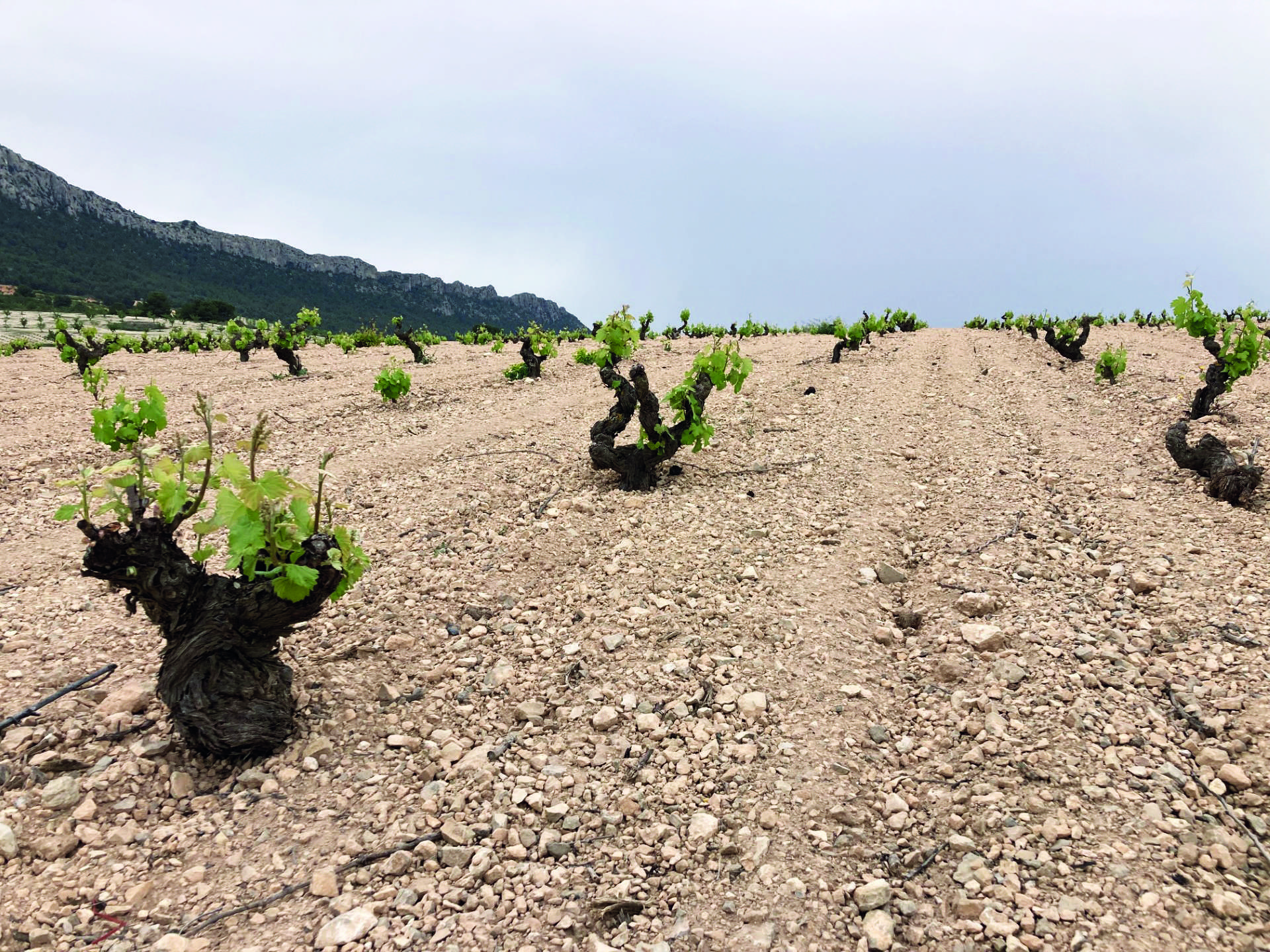
Luckily, Jumilla is also home to one of the most promising drought-resistant grapes in Spain: Monastrell, a red known for its deep, peppery, gamey, berry flavours. Found in rocky, dry soils, it’s a variety that can withstand a lack of moisture thanks to its deep root systems, which burrow underground to find water.
According to María Dugnol, international markets manager at Gil Family Estates (GFE), this is especially true of old Monastrell vines, of which Jumilla has plenty. Surrounded by gnarled Monastrell bushes on GFE’s Juan Gil vineyard, she explains: “In the past three years of drought, we’ve noticed the young vines have suffered more than the older vines.”
A grape that wasn’t always respected, Monastrell’s reputation has shifted over time. According to Miguel Gil, fourth-generation proprietor at GFE, when the business began focusing on Monastrell in the early 2000s, the general opinion was that the wines would not be good quality.
Glad to have gone against the tide, this sentiment is no longer widespread, Gil clarifies. In fact, the grape is so well regarded that it makes up around 80% of all plantings in Jumilla. It is also being shipped more regularly to the UK, with Boutinot as GFE’s main importer.
Available across a range of price points, old-vine Monastrell is saved for GFE’s Silver and Blue labels, with younger grapes reserved for its more accessible fruit-forward options. The very best old vines, meanwhile, are funnelled into El Nido, the group’s luxury winery.
Head winemaker Bartolomé Abellán also reveals he has been working on a 0% version of Monastrell, created through a mix of microfiltration and vacuum distillation. However, translating through Dugnol, he says this was difficult to crack. “It took us over a year to develop it, compared to the other 0% wines.”
Garnacha Tintorera
Just over the border in Murcia’s Almansa region, another climate-resistant grape making an impact is Garnacha Tintorera: a similarly dark and expressive red known for the inky wines it produces. Sometimes called Alicante Bouschet, the grape also has deep root systems but thrives at higher altitudes than Monastrell.
Looking out over the vines, which are as twisted and complex as those in Jumilla, Pepe Sáez, former owner of Atalaya winery, says 90% of the vineyard is Garnacha Tintorera while 10% is Monastrell – a duo sometimes combined to make bold red wines.
Now part of GFE, Dugnol explains that Atalaya was one of the first vineyards acquired by the wine group when it began to expand, even though – like Monastrell – the predominantly Garnacha Tintorera vineyard did not have a strong quality reputation at the time in 2007. “Miguel [Gil] was in love with this variety because he knew its potential. Because of this, Atalaya was the first winery to bottle a 100% Garnacha Tintorera.”
She adds: “Many people thought it wasn’t going to be successful because of how powerful the grape is. But it’s been accepted and is important to a lot of consumers.”
In fact, Dugnol says the wines made with Garnacha Tintorera have been some of the estate’s most awarded, despite them never having been entered into competitions by the winery itself. This is especially true of wines made from grapes grown at 1,000m above sea level, using old, low-yielding vines.
Cross-breeding
Elsewhere in the Murcia region, there are ongoing experiments in cross-breeding grape varieties to further increase drought resistance. Primarily led by Instituto Murciano de Investigación y Desarrollo Agrario y Medioambiental (IMIDA), based nearby, the project has been ongoing since 1997, though only in the past five years have the experimental varieties been added to the Spanish Plant Variety Office.
With the aim of adapting grapes to semi-arid climates, IMIDA’s research is based on cross-breeding Monastrell with other varieties, including Cabernet Sauvignon, Syrah, Tempranillo and Verdejo. Largely a success, according to IMIDA, these new clones demonstrate the remarkable resilience of Monastrell. But Dugnol says these new varieties are not yet widely used.
In her opinion: “It’s mainly all experimental. Sometimes they want to study how the project is specifically applied to certain areas of the appellation, and they’ll ask for a small corner to plant them. But in general, it’s mainly tested at the laboratory or on plots at the university.”
Nonetheless, it is a promising area of research that could prove pivotal in the future. This is particularly poignant given that, by the time of our departure from the region, the rain has passed and the heat is fast approaching once again.
